





Live Online Training
Computer Vision with AI Course
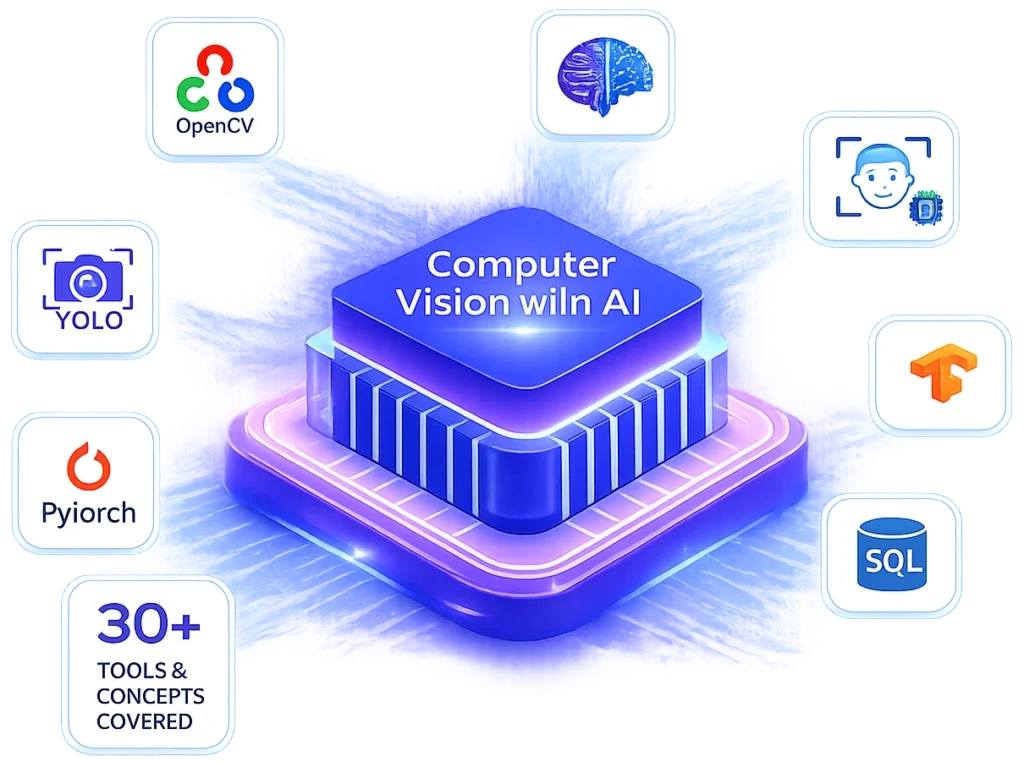
Eight intensive weeks on modern computer vision. OpenCV fundamentals, CNN architectures, object detection with YOLO, image segmentation, and real-time inference. Live GPU lab environment throughout. For engineers targeting healthcare, retail, security, and autonomous systems vision roles.
Live Online Training
Live GPU Lab
YOLO Object Detection
Group Project Capstone
Trusted by Learners & Professionals from Top Companies
WHY LEARN COMPUTER VISION TODAY?
The Specialization Behind Every Vision-Driven Industry
- Computer vision powers healthcare imaging, autonomous systems, and manufacturing
- CV specialists command some of the strongest US technical compensation
- Live GPU lab included — train real detection and segmentation models
- Learn YOLO, Mask R-CNN, and the Segment Anything Model at production depth
- Group project capstone mirrors real vision engineering team structure
WHAT YOU'LL LEARN
OpenCV Fundamentals
CNN Architectures
Vision Transformers
Object Detection (YOLO)
Image Segmentation
Transfer Learning for Vision
Real-Time Inference
Edge Deployment
TOOLS & FRAMEWORKS YOU'LL MASTER
OpenCV
The classical computer vision workhorse
PyTorch
Deep learning backend for CV work
TensorFlow
Alternative framework, still widely used
YOLOv8
Industry-standard real-time object detection

Ultralytics
YOLO training and deployment tools

Detectron2
Facebook AI's segmentation library

Segment Anything (SAM)
Modern prompt-based segmentation

Hugging Face Transformers
Vision Transformers and pretrained models

CUDA
GPU acceleration fundamentals

ONNX
Model interchange for deployment

NVIDIA TensorRT
Inference optimization

Weights & Biases
Experiment tracking for vision

COURSE CURRICULUM
01
02
03
04
05
Week 1
OpenCV & Classical CV
- Image reading, writing, transformations
- Filtering and morphological operations
- Feature detection (SIFT, ORB)
- Working with video
- Classical CV vs deep learning
Week 2
CNN Architectures for Vision
- ResNet, Inception, EfficientNet
- Vision Transformers (ViT, Swin)
- Transfer learning strategies
- Data augmentation for vision
- Custom dataset preparation
Week 4
Object Detection with YOLO
- YOLOv5 and YOLOv8 in depth
- Detection-specific evaluation (mAP, IoU)
- Custom detection datasets
- Fine-tuning YOLO
- Production inference
Week 5
Image Segmentation
- U-Net and semantic segmentation
- Mask R-CNN for instance segmentation
- Segment Anything Model (SAM)
- Segmentation-specific metrics
- Custom segmentation datasets
Week 6
Real-Time & Edge Deployment
- Model quantization and pruning
- Knowledge distillation
- ONNX and TensorRT
- Edge devices (mobile, embedded)
- Real-time inference optimization
What You Will Learn
The Eight-Week Curriculum
The curriculum is intensive and focused. Eight weeks is deliberately compressed — the course assumes the foundational deep learning material is in place and concentrates entirely on the computer vision–specific content that working specialist roles require.
The first module establishes the classical CV foundation that complements deep learning work, plus a focused deep dive into CNN architectures from a vision-specialist perspective.
Topics include OpenCV in depth (image reading/writing, color spaces, geometric transforms, filtering, morphological operations, feature detection, video processing); the CNN architectures revisited at vision-specialist depth (ResNet, Inception, DenseNet, MobileNet, EfficientNet); Vision Transformers (ViT, Swin Transformer) and CNN vs transformer trade-offs; transfer learning in depth; and data augmentation for vision.
You will Explore
OpenCV Deep Dive
CNN Architectures
Vision Transformers
Transfer Learning for CV
Object detection receives two full weeks because it is one of the most commercially important CV capabilities and one of the most architecturally rich subfields. Topics include the evolution of detection (R-CNN family through DETR); YOLO in depth (YOLOv5, YOLOv8) with hands-on training and fine-tuning; detection-specific datasets and evaluation (mAP, IoU); custom dataset preparation and annotation tooling; and detection in production including inference optimization.
The block ends with a substantial project: a custom object detection system trained on a domain-specific dataset.
You will Explore
YOLO Deep Dive
Detection Evaluation
Custom Detection Datasets
Production Inference
Segmentation underlies many of the most valuable industrial CV applications — medical imaging, autonomous perception, manufacturing inspection. Topics include semantic segmentation (U-Net, DeepLab); instance segmentation (Mask R-CNN); panoptic segmentation; the Segment Anything Model and the foundation-model approach to segmentation; segmentation-specific evaluation (IoU, Dice); and custom segmentation dataset preparation.
You will Explore
U-Net & Semantic Segmentation
Mask R-CNN
Segment Anything (SAM)
Segmentation Metrics
The final module covers specialized topics and the engineering practices that distinguish production CV systems. Topics include pose estimation, face detection and recognition; OCR and document understanding; 3D vision basics; real-time inference optimization (quantization, pruning, distillation); edge deployment (NVIDIA TensorRT, mobile); vision data pipelines; vision-specific monitoring; and the build-vs-buy question for vision.
Real-Time Optimization
Edge Deployment
Managed Vision APIs
Vision-Specific Monitoring
The final two weeks are the group project capstone — mirroring the team structure of professional vision engineering work.
Capstone Project
Design • Train • Deploy
A substantial CV application built by a team of 2–3 learners. Recent capstones: defect detection for manufacturing, medical imaging analysis, real-time tracking systems, specialized OCR pipelines.
By the end of eight weeks, you'll have real CV portfolio work built collaboratively — mirroring how professional vision engineering teams actually work.
REAL-WORLD PROJECTS
OpenCV Pipeline
Real-world preprocessing and feature detection project.

Transfer Learning Classifier
Fine-tune a modern CNN on a domain-specific dataset.

Custom YOLO Detection
Train YOLOv8 on your own annotated dataset.
Segmentation Application
U-Net or Mask R-CNN on a real segmentation task.

Group Capstone
Substantive vision application built with a small team.

Course Format and Delivery
The course is delivered fully online through live, instructor-led sessions taught by a working computer vision practitioner from the US technology market.
01
Schedule
Three live sessions per week over eight weeks, in evening and weekend slots that accommodate working professionals across US time zones.
- Each session runs approximately 90 minutes.
02
Live GPU Lab Throughout
Pre-configured GPU environment with PyTorch, OpenCV, and common datasets. No local GPU required.
- Real GPUs. Real training.
03
Cross-Industry Use Cases
The course draws from healthcare, retail, security, and manufacturing throughout — building cross-domain instincts.
- Skills that transfer across industries.
04
Group Project Structure
Capstone is a small-team project mirroring professional vision engineering work.
- Build collaboration alongside technical skill.
05
Code Reviews
Major projects and the capstone receive detailed code review with written feedback.
- Ship-quality feedback.
Prerequisites And Technical Requirements
This is an advanced course. Prerequisites are real:
ML foundation — supervised learning workflows (ML Bootcamp recommended)
Deep learning background — CNN basics (DL course recommended)
Strong Python with PyTorch familiarity
Working calculus and linear algebra
Why Computer Vision Skills Matter In The Us Job Market
A Specialty With Concentrated Demand.
Computer vision skills open a specific class of roles — CV engineer, perception engineer, applied vision scientist — with concentrated demand at autonomous systems, healthcare imaging, manufacturing automation, retail tech, and security companies. The specialization commands a premium.
Compensation That Reflects the Specialization.
Entry-level CV roles commonly start in the low-to-mid six-figure range. Mid-career practitioners reach mid-to-high six-figures. Senior practitioners at vision-focused companies and frontier AI labs reach considerably higher.
Cross-Industry Applicability.
Unlike some AI specializations concentrated at a few companies, CV skills are needed across autonomous systems, healthcare, manufacturing, retail, security, agriculture, and the broader population of vision-intensive industries.
Learn From Industry Leaders
Michael Anderson
Lead Instructor — AI & Cloud
- AWS Certified
- 10+ Years Industry Experience
- Published AI Researcher
Senior AI engineer with extensive experience designing machine learning platforms and deploying enterprise AI solutions.
David Miller
Cloud & MLOps Instructor
- Cloud Architect
- Google Cloud Certified
- Enterprise MLOps Specialist
Cloud Architect specializing in scalable AI infrastructure, MLOps automation, and multi-cloud deployments for enterprise.
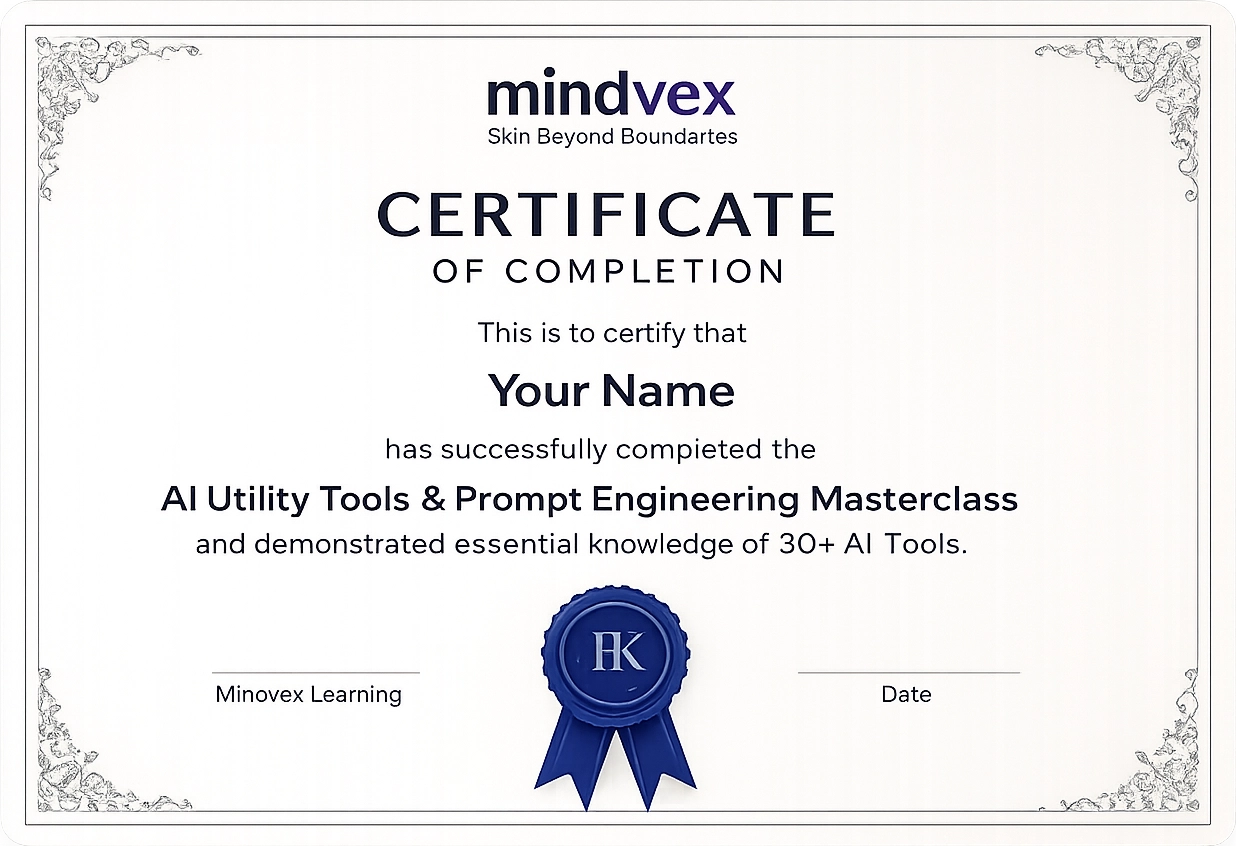
INDUSTRY RECOGNIZED CERTIFICATE
Receive an industry-recognized certificate after successful course completion.
- Industry Recognized
- LinkedIn Shareable
- Verifiable Certificate
- Career Boost
Career Impact
GPU Lab
Included, no extra cost
What Our Learners Say
The AI for Data Analytics course gave me the exact tools needed to interpret complex data streams quickly. The practical framework for integrating modern AI directly into existing analytical workflows was immediately applicable.

The multi-agent simulations in the Advanced Python for LLM & Multi Agent Systems course completely transformed our engineering team's approach to complex system design. Exceptional depth and real-world utility.

Enrolling our product team in Agentic AI & Multi Agent Autonomous Systems provided the strategic edge we were missing. The hands-on project structures made deploying autonomous agents far more straightforward.

After taking NLP with LLMs, I was able to fine-tune and deploy a custom retrieval-augmented model in weeks. The instructors cover production-grade deployment strategies that you rarely find in standard online courses.

The Executive Diploma in Deep AI & Cloud Intelligence offered a clear, high-level strategic overview without glossing over technical rigor. It helped our leadership team align our enterprise cloud architecture with modern AI solutions.

Bridging the gap between prototype models and production infrastructure can be tough, but MLOps & AI in Production laid out the best practices clearly. Highly recommended for any engineering group scaling AI services.
Ready To Specialize In Vision?
Join a cohort of engineers building modern computer vision capability.
Frequently Asked Questions
Working calculus and linear algebra at the undergraduate level. The course uses mathematical concepts at working depth, not research depth. Learners without the foundation should plan additional preparation.
For most learners, yes. The course assumes working understanding of CNNs, training dynamics, and standard DL workflow. The Mindvex Deep Learning course is the recommended preparation.
Yes. Object detection receives two full weeks, with YOLO as the headline architecture. Learners train YOLO models, fine-tune on custom datasets, and deploy them.
No. The course provides GPU lab access throughout.
Yes. Week 6 covers edge deployment, model quantization, pruning, and the engineering patterns for resource-constrained hardware.
The course gives a working foundation supporting either applied or research paths. Research-track learners may want to supplement with deeper academic preparation.
- Live GPU Lab
- YOLO Deep Dive
- Group Capstone
- Practitioner Instructor