






Live Online Training

Advanced Python for LLM & Multi Agent Systems Course

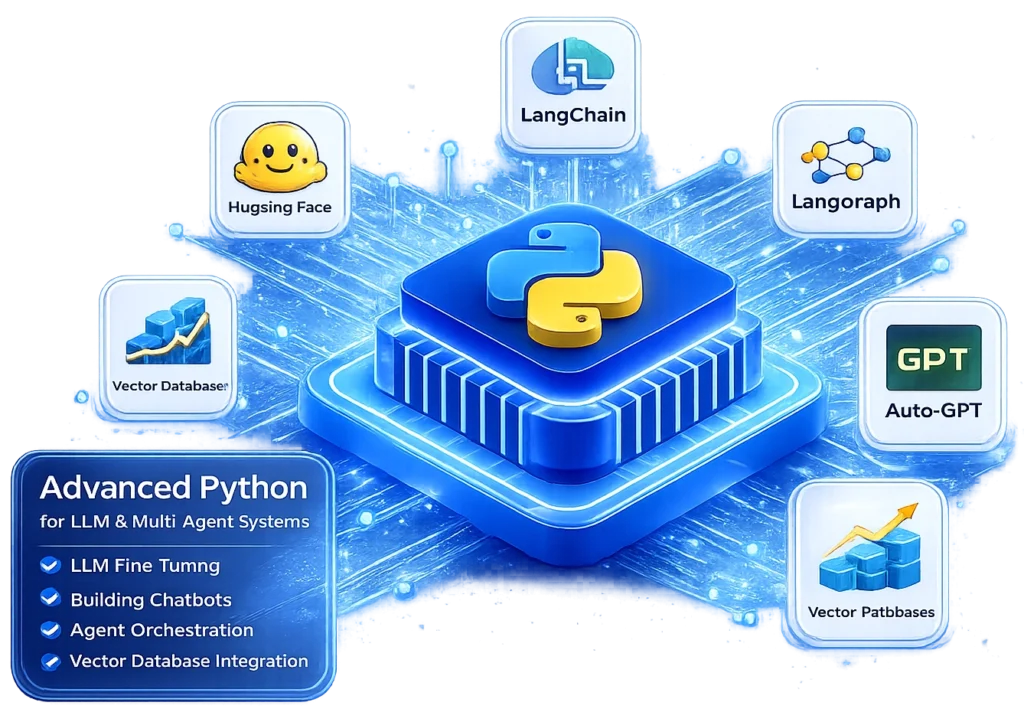
Move beyond LLM basics. Build production-grade LLM applications, RAG systems, and multi-agent architectures in Python. Master async, structured outputs, LangChain, LangGraph, and the engineering patterns behind real AI products. For engineers ready to work at the frontier.

Live Online Training

Production Engineering

LangChain & LangGraph

Industry Certificate

Trusted by Learners & Professionals from Top Companies

WHY LEARN LLM ENGINEERING TODAY?

Build What Every AI Company Now Ships

WHAT YOU'LL LEARN

Advanced Python for AI

Async Programming (asyncio)

LLM API Integration

Structured Outputs & Function Calling

RAG System Design

Vector Databases

Agent Frameworks (LangChain / LangGraph)

Production Engineering & Testing

TOOLS & FRAMEWORKS YOU'LL MASTER

Python 3.12

Modern typed Python for production AI

FastAPI

The async API framework of choice for LLM apps

LangChain

Widely adopted LLM application framework

LangGraph

Stateful graph-based agent orchestration

OpenAI API

The GPT family through code

Anthropic API

Claude models for reasoning-heavy tasks

Pinecone

Managed vector database at scale

Weaviate

Open-source vector DB with hybrid search

Chroma

Local vector DB for prototyping

Hugging Face

Open-weight models and inference

Pydantic

Structured data and validation

Poetry

Modern Python dependency management

COURSE CURRICULUM

01

02

03

04

05

Week 1

Advanced Python for AI

Week 3

Async & I/O for LLM Apps

Week 5

LLM APIs & Structured Outputs

Week 8

RAG Systems & Vector Databases

Week 11

Multi-Agent Orchestration

What You Will Learn

The Twelve-Week Curriculum

The curriculum is organized into four progressive modules across twelve weeks. Each module ends with a practical project that integrates the techniques from that block, and the course as a whole culminates in a full multi-agent system as the capstone.

01

Module 1

Advanced Python for AI Engineering

Module 1 covers the parts of Python that introductory courses skip but that production AI engineering depends on. Learners work through type hints and static typing with mypy, Pydantic for structured data, asyncio for the I/O-bound reality of LLM APIs, decorators and context managers, modern dependency management with Poetry, logging and observability, and testing patterns for code with stochastic outputs.
By the end of Module 1, learners are writing Python that would pass code review at a US AI company — not just Python that runs.

You will Explore

Type Hints & Pydantic

asyncio & Concurrency

Testing Stochastic Systems

Modern Python Tooling

02

Module 2

LLM Integration and Application Patterns

Module 2 moves from advanced Python into direct work with foundation models through their APIs. Topics include the OpenAI, Anthropic, and Google APIs; structured outputs and function calling as the backbone of reliable LLM applications; prompt engineering for application developers (distinct from conversational prompting); caching, batching, and cost management; evaluation and quality control; and streaming for real-time user experiences.

The module ends with a project: a working LLM-powered application with structured outputs, error handling, caching, and basic evaluation.

You will Explore

Multi-Provider LLM APIs

Function Calling & Structured Outputs

Cost & Latency Engineering

LLM Evaluation Basics

03

Module 3

Retrieval-Augmented Generation and Vector Databases

Module 3 focuses on RAG, the architectural pattern behind most production LLM applications that work with custom data. Topics include embeddings and semantic search; hands-on work with Pinecone, Weaviate, Chroma, and pgvector; document processing pipelines and chunking strategies; retrieval evaluation independent from generation quality; and advanced RAG patterns including multi-step retrieval, query rewriting, and re-ranking.

The module ends with a working RAG system built end-to-end against a real document corpus.

You will Explore

Embeddings & Semantic Search

Vector Databases Deep Dive

Chunking & Document Pipelines

Advanced RAG Patterns

04

Module 4

Multi-Agent Systems and Autonomous Workflows

The final module covers the architectural frontier of LLM applications. Topics include hands-on work with LangChain and LangGraph; tool use and tool design; multi-agent orchestration patterns (supervisor-worker, peer-to-peer, debate and verification); state management in agent systems; monitoring and debugging agents; and practical safety and guardrail patterns for keeping autonomous agents within bounds.

LangChain & LangGraph

Tool Design for Agents

Multi-Agent Orchestration

Safety & Guardrails

The final two weeks are dedicated to the capstone: a complete multi-agent system built by each learner, scoped to a real problem, presented in the final session.

Capstone Project

Architect • Build • Deploy

A complete multi-agent LLM application built end-to-end — structured outputs, RAG, tool use, and orchestration — scoped to a real problem you present in the final session.

By the end of twelve weeks, you'll have shipped a real LLM application worth showing in interviews at US AI companies.

REAL-WORLD PROJECTS

Async LLM Wrapper Library

Build a production-grade Python wrapper with retries, caching, and streaming.

Domain RAG Assistant

End-to-end retrieval system on your chosen document corpus.

Structured Output Extractor

Turn unstructured documents into validated data.
Multi-Agent Research Assistant

Coordinated agents for research and synthesis.

Custom Agent with Tool Library

An agent with domain-specific tools you design and build.

Course Format and Delivery

The course is delivered fully online through live, instructor-led sessions taught by working AI engineers from US technology companies.

01

Schedule

Three live sessions per week over twelve weeks, in evening and weekend slots that accommodate working professionals across US time zones.

02

Recordings

Every session recorded and available within 24 hours.

03

Cohort Interaction

Small class sizes ensure every learner gets direct instructor interaction. Cohort discussion channel active throughout.

04

Live Coding

Every session is a hands-on build. Learners write production Python during class, not just watch demonstrations.

05

Code Reviews

Capstone and major project submissions receive detailed written code review from working practitioners.

Prerequisites and Technical Requirements

This is a genuinely intermediate course. Prerequisites are enforced because learners without the foundation fall behind quickly.

Working Python proficiency — functions, classes, dictionaries, standard library

Familiarity with Git, the command line, and basic API calls in code

A laptop with at least 16 GB of RAM and a modern OS

Plan for 9–13 hours per week (3 live sessions + independent practice + project work)

Why LLM Engineering Skills Matter In The Us Job Market

The Highest-Demand Technical Specialty in AI.

LLM engineering is currently one of the most quickly growing roles in US technology. Job titles that specifically require this skill set — AI engineer, LLM engineer, applied AI engineer, generative AI engineer — appear in employer listings faster than qualified candidates can fill them.

Compensation That Reflects the Scarcity.

Mid-to-senior LLM engineering roles at well-funded AI companies and large technology employers regularly reach into high six-figure total compensation, with the top end of the market reaching seven figures at frontier AI labs. Demonstrated production capability — not just theory — is what unlocks the higher end of these ranges.

From Prototyper to Ship-Ready Engineer.

Most self-taught LLM builders can prototype. Few can ship production systems that handle real user load, real edge cases, and real cost constraints. This course closes exactly that gap — the difference between a demo that impresses and a system that runs.

Learn From Industry Leaders

Michael Anderson

Lead Instructor — AI & Cloud

Senior AI engineer with extensive experience designing machine learning platforms and deploying enterprise AI solutions.

David Miller

Cloud & MLOps Instructor

Cloud Architect specializing in scalable AI infrastructure, MLOps automation, and multi-cloud deployments for enterprise.

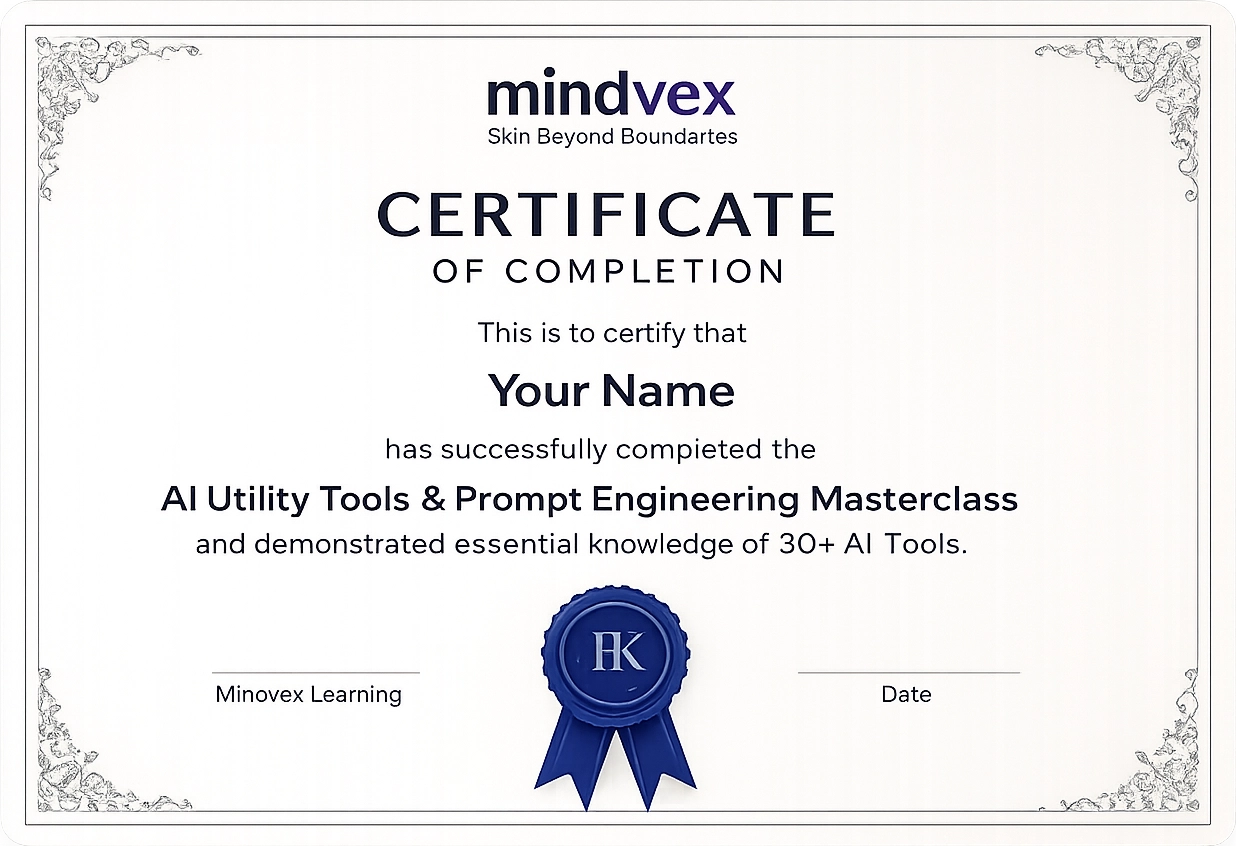
INDUSTRY RECOGNIZED CERTIFICATE

Receive an industry-recognized certificate after successful course completion.

Career Impact

Typical US mid-career LLM engineering compensation range
$ 0 K+
Weeks from LLM basics to shipping a multi-agent system
0 +
Production-grade projects added to your portfolio
0
Real capstone worth showing in interviews
0 +

What Our Learners Say

Ready To Ship Real LLM Systems?

Join a cohort of engineers building production-grade AI applications.

Frequently Asked Questions

The introductory Python for AI & Data Science course teaches Python from scratch with focus on NumPy, Pandas, and statistics. This course assumes you already have that foundation and focuses on the language features (async, typing, modern tooling) and ecosystem (LLM APIs, vector databases, agent frameworks) that AI engineering specifically requires.

Yes, and this is actually a common profile in the cohort. The course focuses on the engineering side of LLM work, not the ML theory side. Software engineers without an ML background often find this course more directly career-relevant than the classical ML track.

No. The course works entirely with LLM APIs, not with model training, so no GPU is required.

LangChain, LangGraph, and direct construction of agents using the OpenAI and Anthropic APIs. The course is deliberately balanced between framework-based and framework-free approaches because both patterns appear in real production codebases.

These are referenced and demonstrated where relevant. The course does not attempt comprehensive coverage of every framework because the landscape changes faster than any curriculum can keep up. The focus is on underlying concepts, with hands-on work in the frameworks that are most stable and widely used in production.

Yes, if you already have working Python proficiency from elsewhere. What matters is the skill level, however it was acquired.

The LLM ecosystem evolves quickly, but the underlying concepts — structured outputs, RAG architectures, agent patterns, async Python — have stabilized enough that the foundational material remains valuable. Specific frameworks and APIs are updated each cohort.

Most employers in this space evaluate candidates on demonstrated technical work — code samples, project repositories, technical discussions in interviews — rather than on credentials alone. The course is designed to produce work that holds up to that kind of evaluation.

Start Building at the Frontier!

Limited seats available. Enroll now and ship your first production LLM system.