



Live Online Training

Python for AI & Data Science

Python for AI & Data Science Course Subhead: Learn Python from scratch and build the working foundation for AI, machine learning, and data science careers. Master NumPy, Pandas, and the data toolkit through live coding labs. Build a real GitHub portfolio in eight weeks — no prior programming experience required.

Live Online Training

Beginner Friendly

GitHub Portfolio Included

Industry Certificate

Trusted by Learners & Professionals from Top Companies

WHY LEARN PYTHON TODAY?

The Language Behind Every AI Career

WHAT YOU'LL LEARN

Python Fundamentals

NumPy for Numerical Data

Pandas for Data Analysis

Data Visualization

Data Cleaning & EDA

Statistics for ML

Jupyter & Version Control

GitHub Portfolio Building

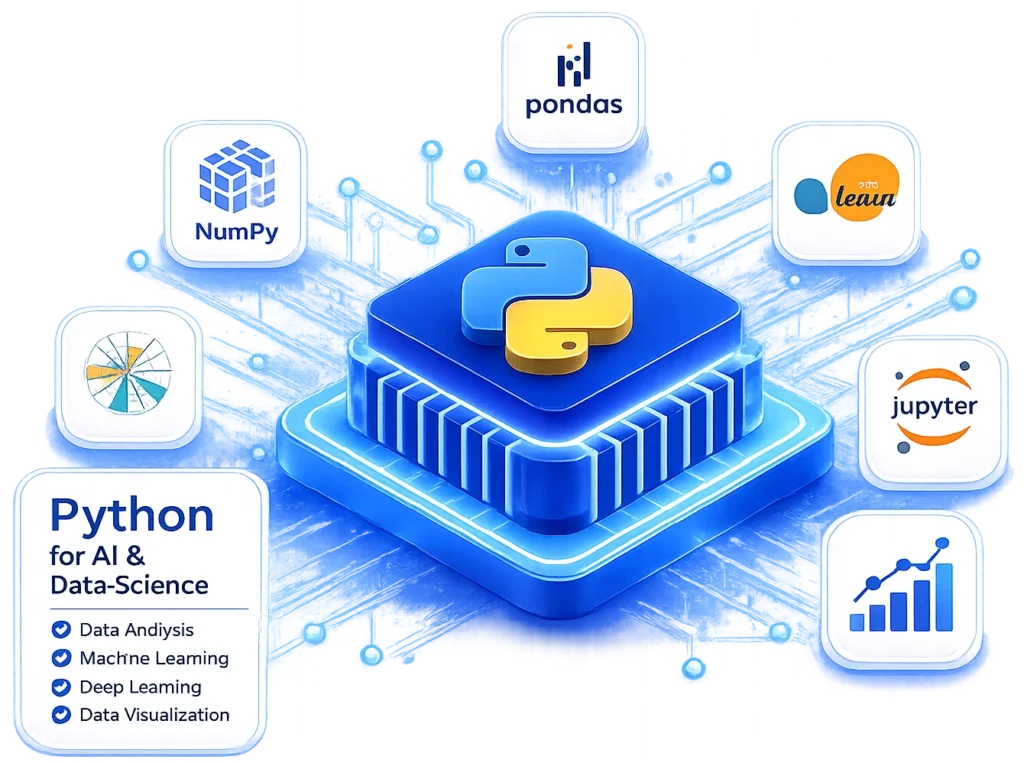
TOOLS & LIBRARIES YOU'LL MASTER

Python

The core programming language of AI and data science

Jupyter Notebook

The standard workbench for data scientists
NumPy

Fast numerical arrays and vectorized computation

Pandas

Tabular data manipulation, the daily workhorse

Matplotlib

The foundational Python visualization library

Seaborn

Statistical visualization on top of Matplotlib
VS Code

Modern code editor for professional Python work

Anaconda

The Python distribution that ships with everything you need

Git

Version control that every developer uses

GitHub

The public portfolio hiring managers actually read
SQL

Query language every analyst and data scientist needs

Google Colab

Cloud notebooks with free compute
COURSE CURRICULUM

01

02

03

04

05

Week 1

Python Fundamentals

Week 2

Working with Data in Python

Week 3

NumPy & Pandas

Week 5

Visualization & Storytelling

Week 7

Data Cleaning & Exploratory Analysis

What You Will Learn

The Eight-Week Curriculum

The curriculum is organized into four progressive blocks across eight weeks. Every session combines instruction with live coding, so concepts are demonstrated, written, and then practiced on real data in the same class.

01

Module 1

Python Fundamentals

The first two weeks build the core programming foundation that everything else depends on. Learners work through variables, data types, control flow, functions, error handling, file input and output, and the standard library essentials — the parts of Python that show up constantly in real data work. Sessions cover reading tracebacks without panic, building small utility scripts, and setting up a professional development environment with Anaconda, Jupyter, and VS Code.

Learners also map out the broader generative AI ecosystem beyond chat — image generation tools like Midjourney and DALL·E, transcription tools like Whisper-based services, research tools like Perplexity, document tools like NotebookLM, and the rapidly growing field of AI-native productivity software. The goal is not memorization but orientation: by the end of Module 1, learners can read AI news critically and make informed choices about which tool fits a given task.

You will Explore

Python Syntax & Control Flow

Functions & Error Handling

File I/O & JSON

Jupyter & VS Code Setup

02

Module 2

The Scientific Python Stack

Module 2 introduces the three libraries that make Python a data language: NumPy, Pandas, and Matplotlib. This is the longest block in the course because fluency here pays back across every subsequent data science and machine learning course learners will take.
NumPy is taught as the foundation of numerical computing: arrays, shapes, vectorized operations, broadcasting, and the mental model of why NumPy runs orders of magnitude faster than equivalent Python loops. Pandas is taught at working depth — Series and DataFrames, reading real messy data, filtering, group-by, merging, missing data handling, and the time series basics. Matplotlib and Seaborn cover visualization, with attention to the more important skill of choosing the right chart for the question being asked.

You will Explore

NumPy & Vectorized Computation

Pandas Deep Dive

Matplotlib & Seaborn

Excel-to-Python Translation

03

Module 3

Data Cleaning and Exploratory Data Analysis

Real-world data is never clean. Module 3 teaches the practical workflows that data professionals use every day to take messy raw data and turn it into something analyzable. Topics include reading from multiple file formats (including the problematic real-world cases like inconsistent encodings and ragged columns), identifying and handling missing values with judgment, detecting outliers using both statistical and domain-driven methods, type coercion, string cleaning, and the long tail of small data quality issues that accumulate in real datasets.
Learners work with publicly available US datasets throughout this module, including data from the US Census Bureau, the Bureau of Labor Statistics, and large consumer-facing open data sources. Working with real US data rather than abstract sample data is a deliberate choice — it builds the contextual instincts that hiring managers look for in interviews.

You will Explore

Handling Missing Data

Outlier Detection

Joining & Reshaping Tables

Real US Public Datasets

04

Module 4

Statistics for Machine Learning

The final week is a focused introduction to the statistical ideas that every machine learning practitioner uses. The goal is not to turn learners into statisticians — it is to make sure the move from data manipulation into predictive modeling is not blocked by missing concepts.

Descriptive Statistics

Distributions & Sampling

Correlation & Causation

Bridge to Machine Learning

Topics include descriptive statistics (mean, median, variance, percentiles), the major distributions and their practical implications, correlation versus causation, sampling and confidence intervals, hypothesis testing taught with code rather than chalkboard derivations, and a first look at predictive thinking — training data versus test data, the concept of generalization, and the bridge into the Machine Learning Bootcamp.

Capstone Project

Analyze • Visualize • Publish

A complete data analysis on a real US public dataset — cleaned, analyzed, visualized, and pushed to your GitHub as your first professional portfolio piece.

By the end of eight weeks, you'll have working Python fluency, real code on GitHub, and the foundation every serious AI course requires.

REAL-WORLD PROJECTS

US Census Data Analysis

Build a compExplore population, income, and demographic trends with Pandas.lete AI-powered blogging system.

Housing Price Explorer

Clean, analyze, and visualize a real US housing dataset.
Consumer Spending Dashboard

Build a multi-chart visualization of retail data.
Public Health Data Study

Work with CDC public data to answer real questions.
GitHub Portfolio Kickoff

Publish your cleaned notebooks and analyses as your first portfolio.

Course Format and Delivery

The course is delivered fully online through live, instructor-led sessions taught by working Python and data science practitioners. Every session includes live coding — you type alongside the instructor, then attempt variations on your own with supervised feedback.

01

Schedule

Three live sessions per week over eight weeks, scheduled in evening and weekend slots that work for full-time professionals across US time zones

02

Recordings

Every session is recorded and made available within 24 hours for review or catch-up.

03

Cohort Interaction

Small class sizes ensure every learner gets direct instructor interaction. A cohort channel stays active throughout for questions between sessions.

04

Live Coding Labs

Every session is a hands-on coding lab. Learners write code, debug it, and use it on real datasets in the same session.

05

GitHub Portfolio

Set up your GitHub account in Week 1 and push working code throughout. Graduate with a real public portfolio.

Prerequisites and Technical Requirements

The course is built for beginners. No coding experience required.

Comfort with high school algebra (no calculus or linear algebra needed)

A laptop with at least 8 GB of RAM, macOS / Windows 10+ / Linux

Willingness to spend 5–7 hours per week on independent practice

Free installation of Anaconda (walked through in Session 1)

Why Python Skills Matter In The Us Job Market

The Language of Every AI Career.

Python is the most frequently requested programming language in US data, AI, and quantitative job postings. Every subsequent step — machine learning, deep learning, LLM engineering, AI product work — is built on Python. Skipping this foundation is the most common reason career changers stall halfway.

Analyst-to-Data-Scientist Bridge.

For Excel and SQL analysts, adding Python is the single most reliable path to expanded scope, larger datasets, and the technical credibility that separates senior analysts from junior ones. Most senior US analyst roles now list Python as a required or strongly preferred skill.

The Portfolio That Gets You Interviews.

Hiring managers do not read certificates — they read GitHub. Learners graduate with a real, public repository of cleaned notebooks and analyses that recruiters and hiring teams can actually inspect. This portfolio is the single most important employment asset the course produces.

Learn From Industry Leaders

Michael Anderson

Lead Instructor — AI & Cloud

Senior AI engineer with extensive experience designing machine learning platforms and deploying enterprise AI solutions.

David Miller

Cloud & MLOps Instructor

Cloud Architect specializing in scalable AI infrastructure, MLOps automation, and multi-cloud deployments for enterprise.

INDUSTRY RECOGNIZED CERTIFICATE

Receive an industry-recognized certificate after successful course completion.

Career Impact

Most requested programming language in US AI job postings
# 0
Weeks from zero to a job-ready GitHub portfolio
0 +
Higher productivity for analysts who move from Excel to Python
0 x
Downstream career paths (data science, ML, AI engineering, quant)
0 +

Frequently Asked Questions

Yes, with honest effort. The course is deliberately structured for first-time programmers and paced so that no prior experience is assumed. The eight-week timeline is realistic if learners put in the recommended five to seven hours of practice per week between live sessions. Learners who skip practice generally do not finish with strong Python skills, regardless of how good the live instruction is.
Three differences. First, the curriculum is structured and progressive — every session builds deliberately on the previous one, which uncurated free content cannot do. Second, the course is live and interactive, so learners get their actual code reviewed and their actual questions answered by a working practitioner. Third, the course is data-focused from day one, while most general Python tutorials spend weeks on material that is not directly relevant to AI and data science work.
Yes. The first session walks learners through installing Anaconda, which sets up Python, Jupyter, and the most common data science libraries in one step. Setup is straightforward on macOS, Windows, and Linux, and live support is provided during the first session for any installation issues.
That is the explicit design goal. Learners who complete this course with reasonable effort meet the prerequisites for the Machine Learning Bootcamp directly.
If NumPy, Pandas, and Matplotlib are already familiar, this course will move too slowly. If they are not, this course is still the right starting point, and the early weeks will simply move faster for you than for true beginners.
This course gives you the foundation that every data science course assumes. Hiring for data science roles in the US typically requires the contents of this course plus the Machine Learning Bootcamp plus one or two domain specializations, depending on the role. An enrollment advisor can map out a specific path based on your target.

Yes, and most learners do. Sessions are scheduled in evening and weekend slots. The realistic time commitment — about ten to twelve hours per week including live sessions and practice — is sustainable alongside full-time work for most learners.

Typical projects include a cleaned and analyzed public US dataset, a multi-source data integration exercise, an exploratory analysis with full visualizations, and a small predictive analysis using the statistical concepts from the final week. Each project is pushed to your GitHub and linked from your resume or LinkedIn.

Start Your Python Journey Today!

Limited seats available. Enroll now and build the foundation for your AI career.