
Deep learning is behind most of the AI people actually notice. The face unlock on your phone. The voice assistant in your car. The chatbot that drafted your last email. The system that flags a suspicious charge on your credit card before you have finished paying for coffee.
It is also one of the most over-explained and under-understood ideas in technology. Explanations tend to either drown you in calculus or wave their hands about artificial brains. This guide aims for the middle: enough to understand what is genuinely happening, without pretending it is simpler or more magical than it is.
Where deep learning sits
Picture three circles, one inside the other. Artificial intelligence is the largest: any system that performs tasks we associate with human intelligence. Machine learning sits inside it: systems that learn patterns from data rather than following hand-written rules. Deep learning sits inside that: machine learning built on neural networks with many layers.
So every deep learning system is a machine learning system, but plenty of machine learning is not deep learning. That distinction matters later, when we get to the question of when you should not use it at all.
A neural network in plain English
Start with a single artificial neuron. It is a simple thing. It takes in a few numbers, multiplies each one by a weight that reflects how important it is, adds them up, and passes the result through a function that decides how strongly to respond. That is it.
One neuron on its own is not very useful. But stack hundreds of them side by side and you have a layer. Stack several layers, where the output of one becomes the input of the next, and you have a network.
Here is the part that makes it interesting. Early layers learn to detect simple patterns. In an image, that might be edges and patches of colour. Middle layers combine those into shapes and textures. Later layers combine those into things we would recognise: an eye, a wheel, a handwritten letter. Nobody programs these features in. The network discovers them because they turn out to be useful for getting the answer right.
How it actually learns
This is the heart of it, and it is more intuitive than it sounds.
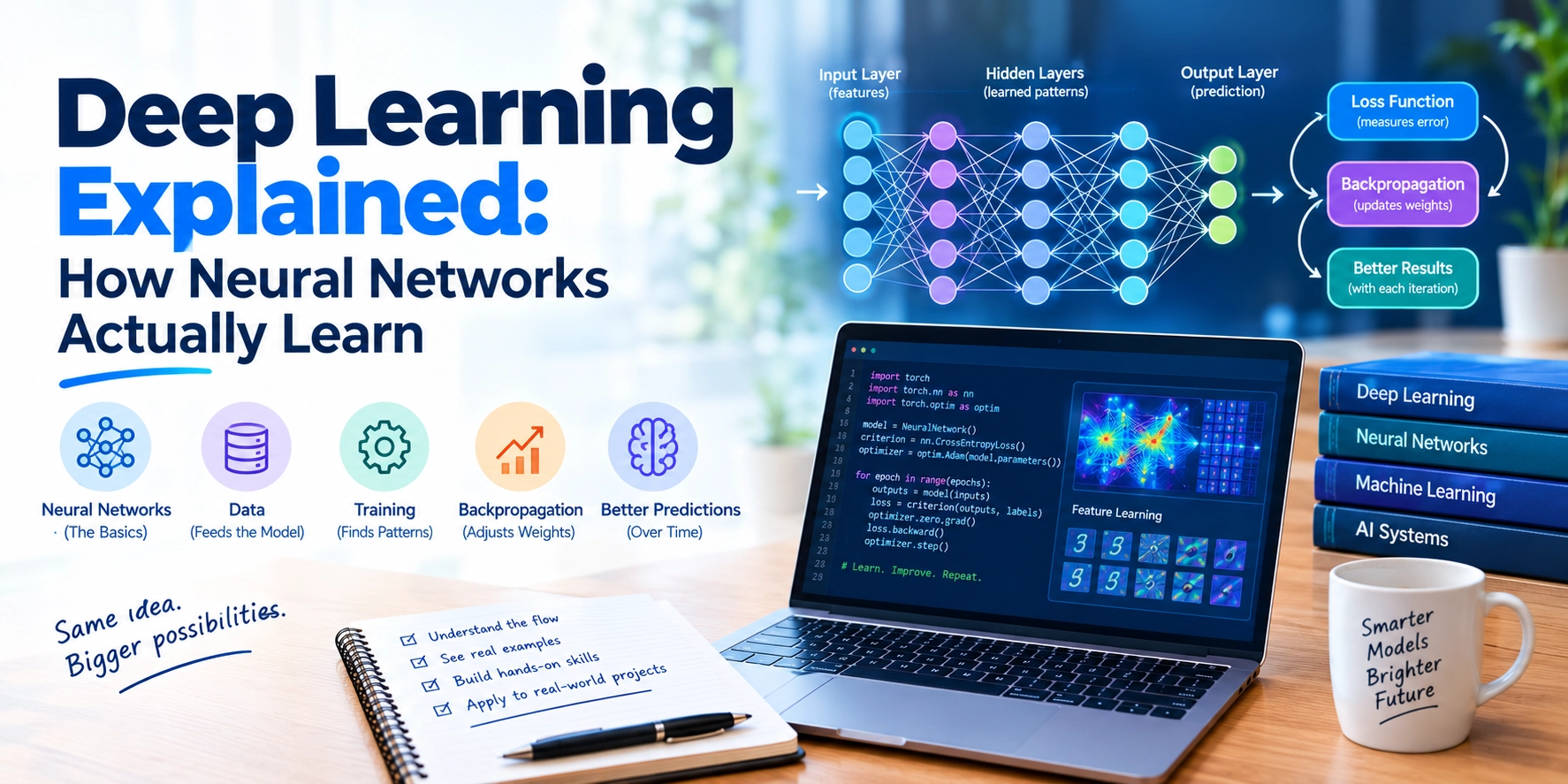
A network starts out with random weights, which means its first guesses are garbage. You show it an example, say a photo labelled ‘cat,’ and it confidently announces ‘truck.’ You then measure how wrong it was. That measurement is called the loss.
Next comes the clever bit. Using a method called backpropagation, the network works backwards from the error and calculates how much each individual weight contributed to it. Then it nudges every weight slightly in the direction that would have made the answer less wrong. This nudging process is called gradient descent.
A useful way to picture it: you are standing on a hillside in thick fog, trying to reach the valley floor. You cannot see the bottom. But you can feel which way the ground slopes under your feet, so you take a small step downhill. Then another. Then another. Repeat that millions of times across millions of examples, and the network gradually settles into weights that produce good answers.
That is genuinely all training is. Guess, measure the error, adjust, repeat. The sophistication is in doing it at enormous scale and in the many practical tricks that keep the process stable.
Why ‘deep’ makes the difference
The ‘deep’ simply means many layers. Researchers knew about neural networks for decades, but shallow ones could only learn relatively simple relationships. Depth lets a network build up complex understanding from simple parts, layer by layer, which is what makes it capable of handling images, audio and language.
For a long time deep networks were too hard to train. Three things changed around the early 2010s. Datasets became vastly larger. Graphics processors turned out to be excellent at the kind of maths neural networks need. And researchers developed better techniques for training very deep models without the process falling apart. Those three together are why deep learning went from academic curiosity to the engine of modern AI in about a decade.
The main architectures you will meet
Different problems call for differently shaped networks. Three families cover most of what you will encounter.
- Convolutional neural networks, or CNNs, are built for images and anything with spatial structure. They scan across an input looking for local patterns, which makes them efficient and powerful for tasks like medical imaging, quality inspection and object detection. They are the foundation of most computer vision work.
- Recurrent networks, including LSTMs, were designed for sequences such as text, speech and time series. They process one step at a time while carrying a memory of what came before. They have largely been overtaken for language tasks but still appear in some forecasting and signal processing work.
- Transformers are the architecture behind modern large language models. Their key idea, called attention, lets every part of an input look at every other part and decide what is relevant. That turned out to scale extraordinarily well, and it now powers not just language models but increasingly vision and audio systems too.
When you should not use deep learning
This is the section most introductions leave out, and it is one of the most practically useful things to know.
Deep learning is hungry. It needs a lot of data, a lot of computing power and a lot of tuning. It is also hard to interpret, which matters in regulated industries such as lending, insurance and healthcare, where you may be required to explain why a decision was made.
For structured, tabular data, the rows and columns you would find in a spreadsheet or database, simpler methods like gradient boosted trees very often match or beat deep learning while being faster, cheaper and easier to explain. Many experienced practitioners start with those and only reach for a neural network when the problem demands it.
Knowing when not to use the most impressive tool is a sign of real expertise. Interviewers notice it.
What you need before you start
Deep learning builds directly on two foundations, and skipping them tends to backfire.
The first is Python, particularly NumPy for working with arrays, since tensors in deep learning frameworks behave very similarly. The second is core machine learning: training and test splits, overfitting, evaluation metrics, and how simpler models like linear regression and decision trees work. If terms like validation set and regularisation feel unfamiliar, spend time there first. Everything in deep learning will make far more sense.
You do not need advanced mathematics. You do need working intuition for vectors and matrices, a basic grasp of what a derivative represents, and some comfort with probability. A good course teaches these alongside the code rather than as a separate hurdle.
What employers actually look for
Hiring managers for deep learning roles in the US tend to probe the same handful of things. Can you build and train a model in PyTorch, not just load a pre-trained one? Can you diagnose why training is failing, whether the loss will not drop, the model is overfitting, or results swing wildly between runs? Do you understand transfer learning, where you adapt a large pre-trained model to a specific task with a much smaller dataset? And can you get a trained model out of a notebook and into something that runs reliably?
Transfer learning deserves a special mention. In practice, very few companies train large networks from scratch. They take an existing model and fine tune it. Being fluent in that workflow is one of the most employable deep learning skills you can have.
How to learn it without getting lost
Build small before you build big. Start with a simple network on a small image dataset and train it on your own laptop. Watch the loss drop. Break it on purpose by changing the learning rate and see what happens. That hands-on feel for training is worth more than any amount of reading.
Then move to a real problem in an area you care about, using transfer learning on a pre-trained model. Document what you tried, what failed and why. That write-up is exactly what makes a portfolio project credible.
If you are still deciding which broader direction suits you, our comparison of machine learning and data science careers may help before you commit.
Mindvex’s Deep Learning & Neural Networks course picks up where the Machine Learning Bootcamp leaves off. It covers how networks learn, CNNs, sequence models, transformers, transfer learning and practical training skills, taught live with hands-on projects throughout. Learners who complete it are well placed to move on to Computer Vision with AI or the Generative AI & LLM programme. Book a demo if you would like help working out whether you are ready to start, or whether the bootcamp is the better first step.