
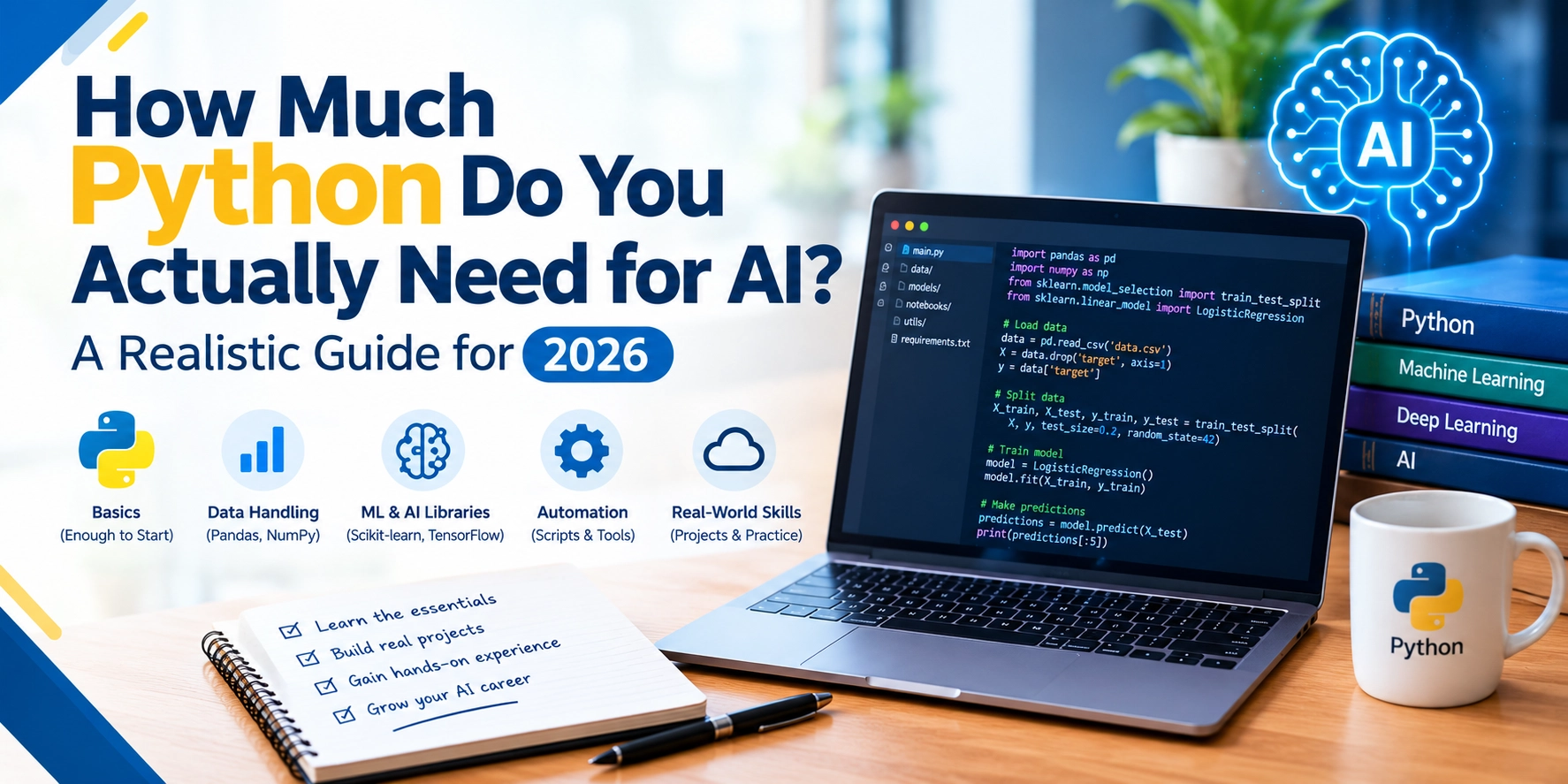
Almost everyone who decides to move into AI asks the same question within the first week. How much Python do I actually need to learn?
It is a fair question, and the internet is bad at answering it. One camp says you need to master computer science fundamentals before touching a model. The other says you can learn everything in a weekend with a chatbot open in the next tab. Neither is true, and following either one will cost you months.
The honest answer is that you need a specific slice of Python, learned properly, in the right order. This guide lays out what that slice is.
Why Python ended up running AI
Python is not the fastest language. It is not the most elegant. Plenty of engineers would happily tell you it has real flaws. So why does nearly every AI team in the United States build in it?
Mostly because of the ecosystem around it. The libraries that power modern AI, including NumPy, Pandas, scikit-learn, PyTorch and the tooling around large language models, all live in Python. The heavy computation underneath is written in faster languages, but you reach it through Python. That makes Python the control panel for the whole field.
It also reads close to plain English, which matters more than people admit. When a data scientist, a machine learning engineer and a product manager all need to look at the same code, readability wins. That is the real reason it stuck.
The short answer to ‘how much’
You do not need to know all of Python. You need to know four layers of it, and you need them in sequence. Skipping ahead is the most common reason people stall around month three.
Think of it like learning to drive. You do not need to understand how a transmission is manufactured. But you do need to be genuinely comfortable steering before anyone lets you onto the freeway.
Layer one: the core language
This is the foundation, and it is where most self-taught learners cut corners. You want real fluency with variables and data types, lists, dictionaries, sets and tuples, loops and conditionals, functions, and basic classes. You should be able to read a function someone else wrote and explain what it does without running it.
Error handling belongs here too. AI code breaks constantly, usually because the data was not shaped the way you expected. Knowing how to read a traceback calmly and find the line that actually caused the problem is worth more than any single library.
A useful test: can you write a small program from a blank file, with no tutorial open, that reads a text file, counts how often each word appears, and prints the top ten? If yes, you are ready to move on. If not, stay here a little longer. It pays off.
Layer two: the data stack
Once the core feels natural, you move into the tools that handle data. This layer is where AI work actually happens day to day, and it surprises people how much of the job lives here.
- NumPy, for working with arrays and numerical data efficiently. Every model you will ever train is doing maths on arrays underneath.
- Pandas, for loading, cleaning, filtering, merging and summarising tabular data. Expect to spend more time in Pandas than in any model library.
- Matplotlib or Seaborn, for plotting. You cannot fix data you cannot see, and a quick chart often reveals a problem that hours of staring at numbers would miss.
- Jupyter notebooks, for exploration. They are not where production code lives, but they are where most analysis starts.
Real datasets are messy. Missing values, inconsistent date formats, duplicate rows, a column that says ‘N/A’ in six different ways. Learning to clean that up quickly is the unglamorous skill that separates people who get hired from people who do not.
Layer three: the machine learning libraries
Now the part most people want to start with. Scikit-learn is the right entry point. It covers regression, classification, clustering, model evaluation and preprocessing with a consistent, readable interface. You can build and evaluate a genuinely useful model in fewer than thirty lines.
After that comes a deep learning framework. PyTorch is the dominant choice in both research and industry in 2026, so that is where we would point most learners. You do not need to master it immediately. You need to understand tensors, how a simple network is defined, and what a training loop is doing.
From there the modern generative AI layer opens up: calling large language model APIs, working with embeddings, building retrieval systems. All of it assumes you are comfortable with layers one through three.
Layer four: writing Python like an engineer
This is the layer that tutorials skip and employers check. It covers virtual environments and dependency management, so your project runs on someone else’s machine. Git, so your work is versioned and shareable. Basic testing, so you know when a change broke something. And simple APIs, so a model can be called by another application.
None of this is difficult. It is just easy to ignore when you are learning alone. But the first time a hiring manager opens your portfolio repository, they are looking at exactly these things.
What you can safely skip, at least for now
You can leave a surprising amount of Python on the shelf. Advanced metaprogramming, decorators beyond the basics, writing your own C extensions, deep knowledge of concurrency, and most web framework internals are all things you can pick up later if a role demands them. They are not prerequisites for AI work.
Knowing what to ignore is half the battle. Learners who try to cover everything usually finish nothing.
Do AI coding assistants make learning Python pointless?
This comes up in almost every conversation now, and it deserves a straight answer. No. They make learning Python more important, not less.
AI assistants are genuinely good at writing boilerplate and suggesting code. They are also confidently wrong often enough that someone has to catch it. If you cannot read the code the assistant produced, you cannot tell whether it quietly dropped a third of your data or used the wrong evaluation metric. Those mistakes do not throw errors. They just produce wrong answers that look right.
The professionals getting the most out of these tools are the ones who already understand the code. They use the assistant to move faster, not to avoid thinking. That is the position you want to be in.
The traps that slow people down
Tutorial loops are the big one. Watching someone else write code feels productive, and it is not. After every lesson, close the video and rebuild what you just saw from memory. It will be uncomfortable. That discomfort is the learning.
The second trap is starting with toy datasets and never leaving them. The classic teaching datasets are clean in ways real data never is. As soon as you can, find a dataset from your own industry or interests and work with that instead.
The third is going it alone for too long. Getting stuck for three days on something an instructor could explain in five minutes is not character building. It is just lost time.
A realistic 12 week plan
For someone starting from zero and studying around eight to ten hours a week, this pacing is achievable without burning out.
| Weeks | Focus | Milestone |
| 1 to 3 | Core language | Write small programs from a blank file without a tutorial open |
| 4 to 6 | NumPy, Pandas, plotting | Clean and analyse a messy real world dataset end to end |
| 7 to 9 | Scikit-learn and model evaluation | Build, evaluate and explain a classification model |
| 10 to 12 | Engineering habits and a first project | Publish a clean GitHub repository with a readme and working code |
If you already code in another language, you can likely compress the first phase into a week or two and spend the saved time on the data and modelling layers.
Where to go from here
Python is the entry ticket, not the destination. Once it feels comfortable, the natural next steps are machine learning fundamentals, then deep learning, then the generative AI tools that sit on top. If you want the bigger picture of how that progression fits together, our guide on how to become an AI engineer in 2026 walks through the full route.
Mindvex’s Python for AI & Data Science course is built around exactly these four layers, taught live by instructors who work with the tools every day, with real datasets rather than tidy teaching examples. It is designed as the first step into the Machine Learning Bootcamp and the wider AI track. If you are unsure whether to start with Python or jump in further along, book a demo and we will look at your background with you.